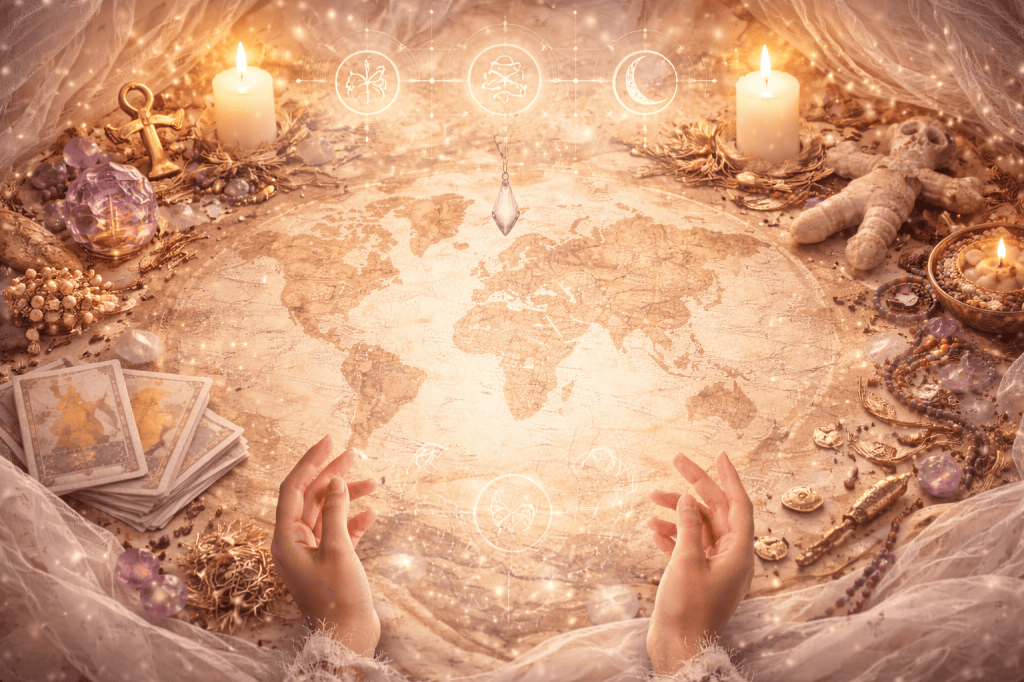
Since the beginning of human history, people have searched for ways to understand the mysteries of life. Long before modern science and psychology, cultures around the world developed spiritual traditions that helped individuals explore questions about fate, destiny, protection, and the unseen forces believed to influence human life.
These practices, often described today as divination or spiritual magic, were rarely about controlling the future. Instead, they were ways to seek guidance, connect with the spiritual world, and bring meaning to life’s uncertainties. From the temples of Ancient Egypt to the ritual traditions of Africa and the Caribbean, many civilizations developed their own sacred systems of symbolism, intuition, and spiritual practice.
Although these traditions differ in culture and ritual, they share a common purpose: helping people navigate life through intuition, reflection, and spiritual connection.
Egyptian Divination and Sacred Magic
Ancient Egypt was one of the earliest civilizations to develop structured spiritual systems connected to divination and ritual magic. For the Egyptians, magic was known as Heka, a sacred force believed to exist throughout the universe. Rather than something mysterious or forbidden, Heka was understood as a natural power that connected the divine and human worlds.
Egyptian priests and priestesses practiced various forms of spiritual guidance, including dream interpretation, astrology, and ritual communication with the gods. Temples often served as places where individuals could seek divine messages, particularly through dreams. People sometimes slept within temple spaces hoping to receive guidance from deities such as Isis, Thoth, or Horus.
Amulets, sacred symbols, and ritual words were also believed to carry protective and spiritual power. These practices were not simply about predicting events but about maintaining balance, harmony, and protection within life and the cosmos.
African Spiritual Traditions and Ancestral Wisdom
Across the African continent, many spiritual traditions developed around the belief that the physical and spiritual worlds are closely connected. These traditions often emphasize the importance of ancestors, nature, and community rituals.
Divination practices may involve sacred objects such as shells, bones, or symbolic tools that are cast and interpreted by spiritual leaders. These patterns are believed to reveal messages from ancestors or spiritual forces guiding the individual.
Rather than focusing solely on fortune telling, these traditions are deeply connected to healing, protection, and maintaining harmony within the community. Spiritual practitioners often serve as healers, guides, and keepers of ancestral wisdom.
Vodou and Afro-Caribbean Spiritual Practice
Vodou, often misunderstood in popular culture, developed through the blending of West African spiritual traditions with elements of Christianity during the period of the transatlantic slave trade. Today, it is practiced mainly in Haiti and parts of the Caribbean.
In Vodou, spiritual beings known as lwa act as intermediaries between the human world and the divine. Rituals, offerings, music, and dance are used to honour these spirits and seek their guidance.
Contrary to many myths, Vodou is not centered on curses or dark magic. Instead, it is a complex spiritual tradition rooted in community, healing, ancestral respect, and spiritual balance.
European Folk Magic and Divination
Throughout Europe, many forms of folk magic and divination developed within villages and rural communities. These practices were often passed down through generations and became part of everyday cultural traditions.
Common forms of divination included:
Tarot and oracle cards Tea leaf or coffee ground reading Crystal gazing Astrology Herbal and seasonal rituals
Many of these traditions were closely connected to the natural world and seasonal cycles. They reflected a deep belief that nature itself held symbolic meaning and spiritual guidance.
Scrying and the Language of Symbols
Another form of ancient divination found across many cultures is scrying, the practice of gazing into reflective surfaces such as water, mirrors, crystals, or polished stones. Practitioners enter a quiet, meditative state and observe images or impressions that may appear.
Rather than seeing literal visions, scrying often produces symbolic impressions that are interpreted intuitively. It reflects the belief that the human mind, when focused deeply, can access layers of awareness beyond ordinary perception.
Humanity’s Timeless Search for Meaning
Despite the differences between cultures and traditions, the practices of divination and spiritual magic share a common theme: the human desire to understand life’s mysteries.
These traditions remind us that people across time have always looked beyond the visible world for meaning, guidance, and reassurance during uncertain moments. Whether through dreams, symbols, rituals, or spiritual practices, humanity has long sought ways to listen to the unseen forces believed to shape our lives.
Today, many people approach these traditions not as absolute predictions but as symbolic tools for reflection, intuition, and personal insight. They continue to inspire curiosity and respect for the diverse spiritual paths that have shaped cultures throughout history.
Article written by:
DivineGuidance.Uk
✨💫🌙✨


Leave a comment